African American Script Font for Brand Personality
Two weeks ago, I held a freshly printed batch of candle labels in my hands—soft kraft paper, minimalist layout, and a font that just… didn’t feel like *me*. My small-batch candle business is all about warmth, intention, and handmade charm—but the typeface I’d been using for “Lavender & Sage” on every jar looked stiff, distant, almost apologetic. That’s when I searched “playful script font for small business branding” and found African American. Not as a historical term or cultural label—but as a Script Handwritten font with personality so vivid, it made my product names smile.
African American for Candle Jar Labels and Handmade Product Packaging
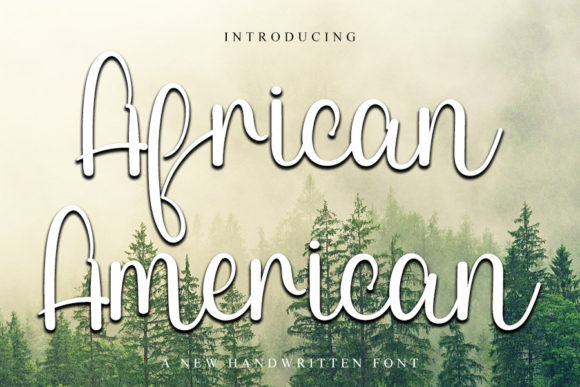
African American is a lovely script font featuring charming, playful characters that seem to dance along the baseline—and that movement? It’s pure magic on candle jars. I swapped out my old sans serif for African American on the front label (just the scent name), kept the ingredients list in a clean sans serif underneath, and suddenly, each jar felt like a little invitation—not just a product. Because African American isn’t meant for paragraphs or fine print; it’s a display font built for moments of connection: the first glance at your shelf, the pause before a purchase, the Instagram close-up that stops a scroll. For packaging, I use it at 24–36 pt on matte stickers and 18–22 pt on curved glass jars—always testing print proofs first, since its delicate loops need breathing room.
African American for Café Menu Design and Local Business Signage
When my neighborhood café friend asked me to help refresh her chalkboard-style menu board, I reached for African American again. Not for prices or allergen notes—but for dish names like “Honey Lavender Latte” and “Sweet Potato Biscuits.” Its bouncy rhythm gives warmth without looking cutesy or outdated. As a Script Handwritten font, it feels personal but polished—like the barista wrote it just for you. On laminated menus, I pair it with a friendly, open-weight sans serif (think Montserrat Light or Poppins Regular) for body text. And yes—it works beautifully in digital signage too: I exported African American as a web font for her Square POS banner, and customers started commenting, “Your menu looks *so* you.” That’s the power of choosing the right Fonts—not just any script, but one with genuine voice.
African American for Social Media Graphics and Instagram Story Highlights
If you’ve ever stared at a blank Canva template wondering why your “New Collection Launch!” graphic feels forgettable—African American might be your quiet upgrade. I use it for short, emotional hooks: “Hand-poured with care,” “Small batch, big love,” “Made while the kettle whistles.” Its playful characters pop on mobile screens, especially against warm neutrals or soft pastels. Just avoid tiny sizes—under 20 pt on Stories gets blurry, and thin strokes vanish on thumbnail previews. Pro tip: layer African American over a subtle texture (like linen or watercolor) to soften contrast and highlight its organic flow. As a Script Handwritten font, it adds humanity fast—no design degree required.
African American for Wedding Invitations and Elegant Branding
Even if you’re not a wedding vendor, this one matters: African American carries elegance without formality. A local florist used it for her “Seasonal Bouquet” subscription cards—and instantly elevated her whole brand perception. Why? Because elegant doesn’t mean stiff. It means intentional, graceful, memorable. African American delivers that in spades: gentle curves, balanced spacing, and a baseline that truly *dances*, giving motion even to still images. For invitations, I recommend pairing it with a refined serif (like Playfair Display) for addresses and dates—letting African American shine on the couple’s names or event title. It’s versatile enough for modern elopements *and* garden celebrations—proof that great Fonts adapt to your audience, not the other way around.
African American for Thank-You Cards and Customer Experience Touchpoints
Your thank-you card is often the last physical thing a customer holds from your business—and the first place they notice care in the details. I switched mine from generic script to African American, and the difference was immediate: handwritten warmth, zero cliché. Its charm comes from variation—not rigid uniformity—so letters have gentle personality shifts (a lifted ‘t’, a looping ‘y’) that mimic real penmanship. When printed on thick cotton paper, those subtleties read as sincerity. Just remember: African American is a Script Handwritten font designed for impact, not utility. Use it for headlines, signatures, and short phrases—not shipping policies or return instructions.
African American for Logo Design and Boutique Brand Identity
Can you use African American in a logo? Yes—if your brand voice is joyful, approachable, and authentically human. I helped a local knitwear boutique test it for their monogram logo (“S + W”), and it struck the perfect balance: crafty but confident, nostalgic but fresh. Because African American is a lovely script font featuring charming, playful characters that seem to dance along the baseline, it avoids looking dated or overly ornate—two common pitfalls with script logos. Before finalizing, we checked the included file formats (OTF and TTF), confirmed commercial licensing covered merchandise and digital templates, and tested legibility at 1” width on woven tags. It passed—because great Fonts earn their place, not just fill space.
How to Pair African American With Other Fonts for Consistent Branding
Think of African American as your brand’s storyteller—and pair it with a clear, calm listener. For most small businesses, that means a neutral sans serif (like Inter, Lato, or Open Sans) for body copy, forms, and website navigation. If your aesthetic leans romantic or editorial, try a light serif (Cormorant Garamond, EB Garamond) for quotes or blog headers. Never pair two heavy scripts—that creates visual noise. And always preview your pairings in real contexts: on a product mockup, in a DM reply, on a receipt footer. Consistency starts with harmony—not just aesthetics.
If your brand feels a little muted, a little safe, or just *missing something*—it might not be your photos, your colors, or your messaging. It could be the quiet, powerful choice of African American: a Script Handwritten font that doesn’t shout, but sings—with charm, playfulness, and unmistakable presence. It’s not just another set of Fonts. It’s the handwriting your brand has been waiting to call its own.